
I love space-based movies. Especially the ones with an engineering problem(s) that needs to be resolved using only what is readily available - materials, talents/skills, headcount, etc. - and the time frame is always dramatically tight.
One of my favorites, “The Martian” with Matt Damon (actually, I prefer the book to the movie) is entirely about how Matt will survive living on Mars alone until the rescue team arrives in 549 Sols (Martian days) using only 300 Sols of rations. Similarly, Tom Hanks in Apollo 13 must get a damaged capsule home with live astronauts after repairing various elements using only what is already inside the capsule. Spoiler alert: both astronauts get home alive despite these challenges. So, how do those movie heroes/heroines make the impossible possible? They had to leverage Manufacturing Informed Design (MID) principles.
In both these movies, the engineering teams back at home created solutions based on what was readily available in the way of materials, and solutioned based on those materials instead of custom-built options. They didn't have the luxury of unlimited time, materials, and labor to construct the solution. They had to get more creative while being ruthless about prioritizing what was truly necessary – the minimum viable product required to achieve the mission.
We are currently in a similar situation with hyperscale data center construction today. We have supply chain issues, headcount constraints, and tight timelines which demand creative and herculean efforts to succeed. We are essentially on Mars needing to build with what we can readily obtain through the established supply chains.
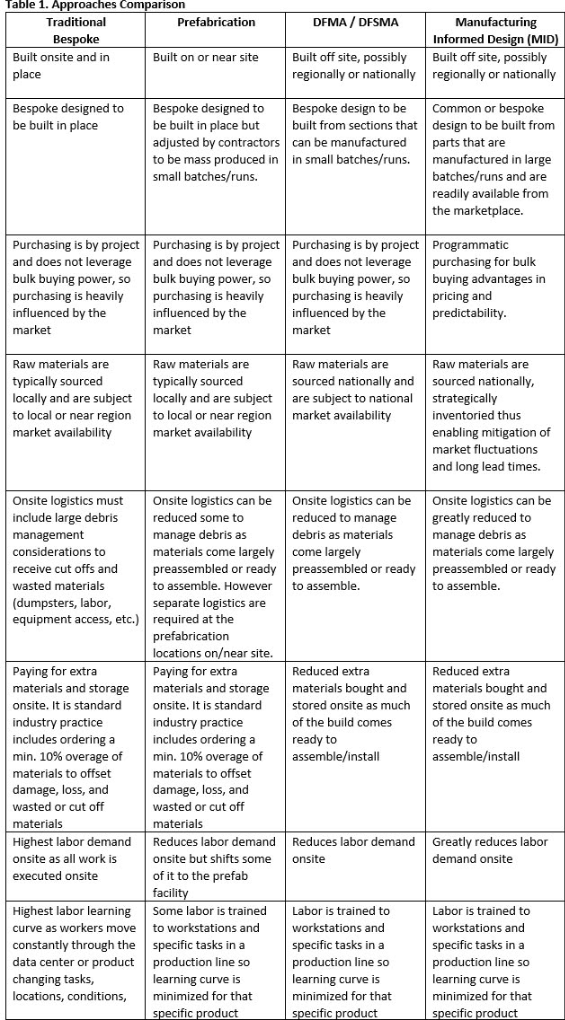
Designing for what is or can be predictably manufactured based on a consistent manufacturing throughput volume. Basically, designing around the pieces, we have on “Mars” with us – bespoke parts and pieces that would never result in a steady production or manufacturing throughput, for anyone. This means evolving our efforts to become extremely creative integrators of design and construction components that are already or could be reliably and predictably manufactured due to the volume/demand created while reducing our non-reoccurring engineering (NRE) spend to design these sections of our products, the Data Centers, repeatedly.
By standardizing these consistent elements (i.e.. components) of our products (i.e. Data Centers), thus creating manufacturable components, we will establish manufacturing throughput volume which enables consistency and predictability within our supply chain. Additionally, this reduction of iteration within our Product’s components makes us more attractive to the manufacturing supply chains that need that stability of design.
Manufacturing Informed Design (MID) creates that necessary manufacturing volume through standardization. We are the main enemies of MID. Yes, us. The people who control the design and construction production. We must control that tendency to want to create a new custom component rather than use what we are already supplying or can get readily from the manufacturing world.
This stability of design enables the pre-purchase of critical materials (e.g., Steel) for those components and purchase using the power of our volume in lieu of buying by project in smaller, more vulnerable supply chains channels. This will lead to creating strategic inventory and enabling programmatic contracting for better pricing and predictable spending while reducing programmatic risk.
That tendency to want to just nudge or iterate that manufactured component “just this once” must be curtailed because creating a one off negates the power of manufacturing volume and thus is the death of predictability. If we control this tendency, we become attractive clients for entire untapped market of vendors who make the consistent manufacturing of standard components their business thus increasing our supply chain strategically reducing risk to our builds. The beauty of MID is that we can standardize the core components – making them product agnostic - reduce any learning curves by our teams, while remaining flexible in the overall design form factor of our products, the data centers.
The main point here is that MID is NOT DFMA (design for manufacturing and assembly) this is something different. While DFSMA takes a custom design and manufactures it for one project using existing construction supply chains, MID takes the components that are available or can be standardized via the existing manufacturing supply chains for volume production supporting multiple projects at a programmatic level.
Questions to ask ourselves as we go deeper on Manufacturing Informed Design (MID)
What components can be standardized and manufactured (or purchased) in bulk across all our DC products?
Can we manufacture those components using non-construction supply chains thus diversifying our risk and spend?
What and how can we design to utilize existing supply chains most effectively? That is, what material bulk buying will this enable and how do we avoid volatile material supply chains?
How can we design to enable optimized manufacturing process thus producing more faster?